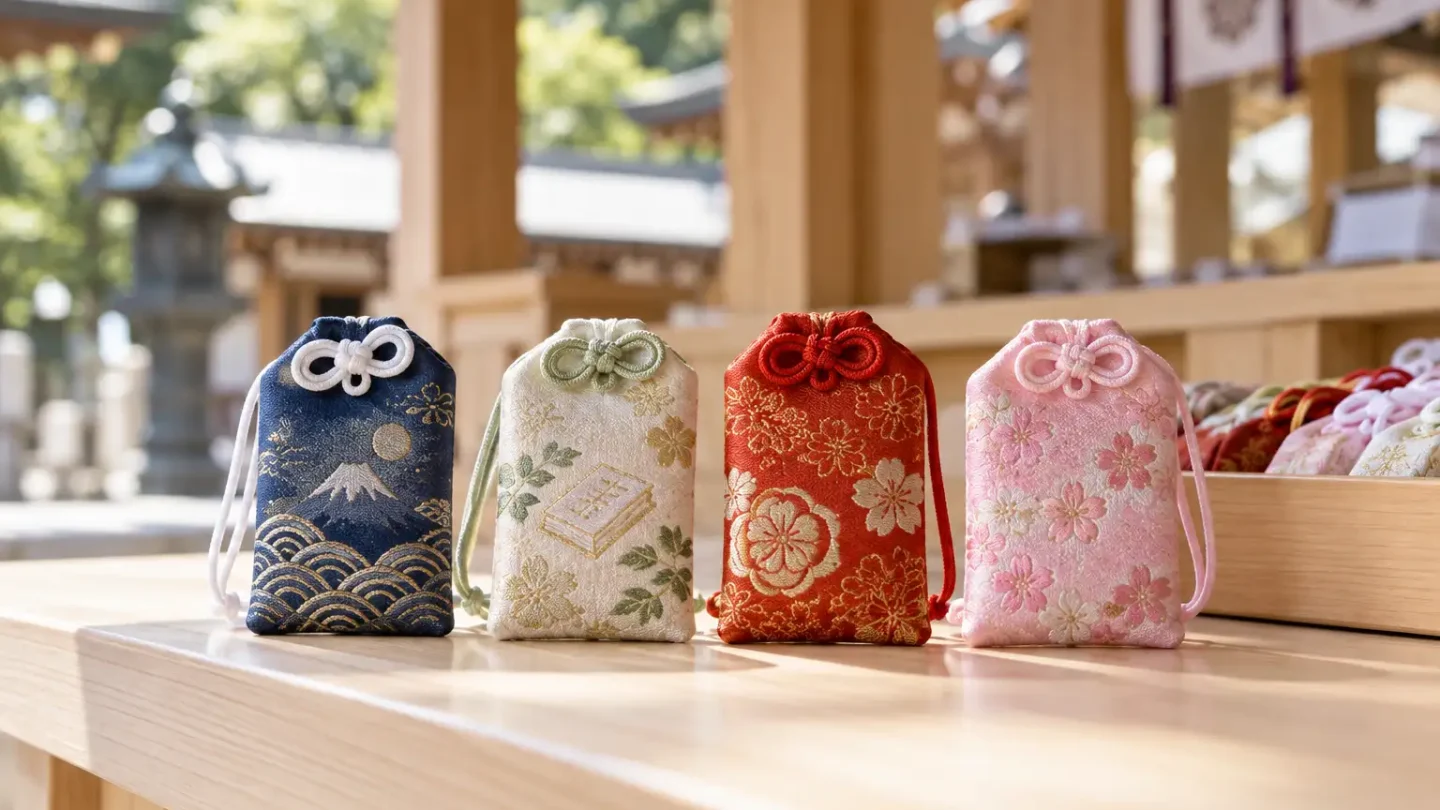
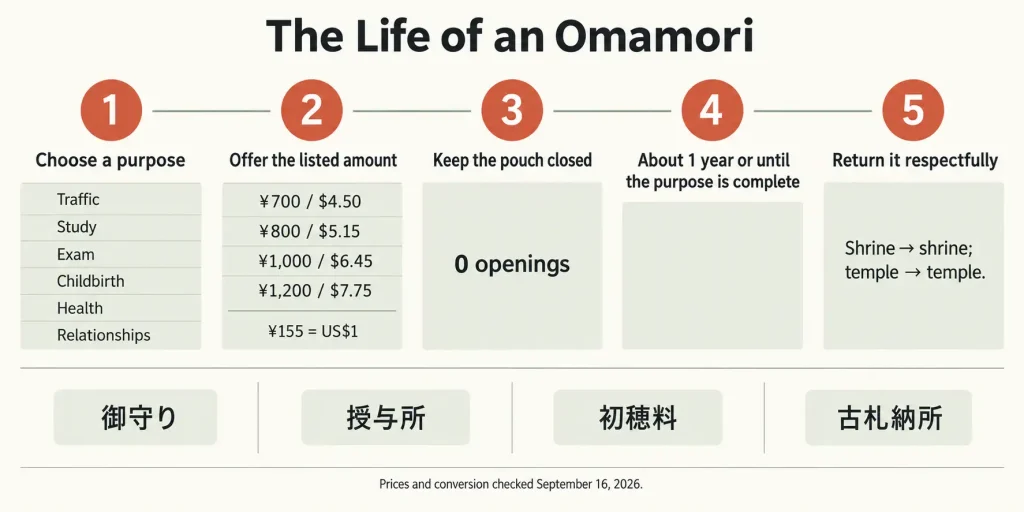
The words you will actually meet begin at the shrine or temple counter: 御守り, omamori, “protection”; 授与所, juyosho, the place where sacred items are conferred; and 初穂料, hatsuho-ryō, the offering requested for one. Later, when a year has passed or the purpose has been fulfilled, you may need 古札納所, kofuda osamejo, the collection point for old amulets and talismans. Understanding the omamori meaning printed on each pouch matters more than choosing the best-looking color.
The practical version is simple. An omamori is normally carried closed, not unwrapped to inspect the object inside. Around one year is a customary replacement point, but it is a guideline rather than a supernatural expiration date. When you are finished with the charm, the respectful option is to return it to an appropriate shrine or temple instead of dropping it in a hotel trash can.
If shrine and temple vocabulary is still blurring together, How Shinto and Buddhism Actually Show Up explains why people in Japan can obtain amulets from both without treating that as a contradiction.
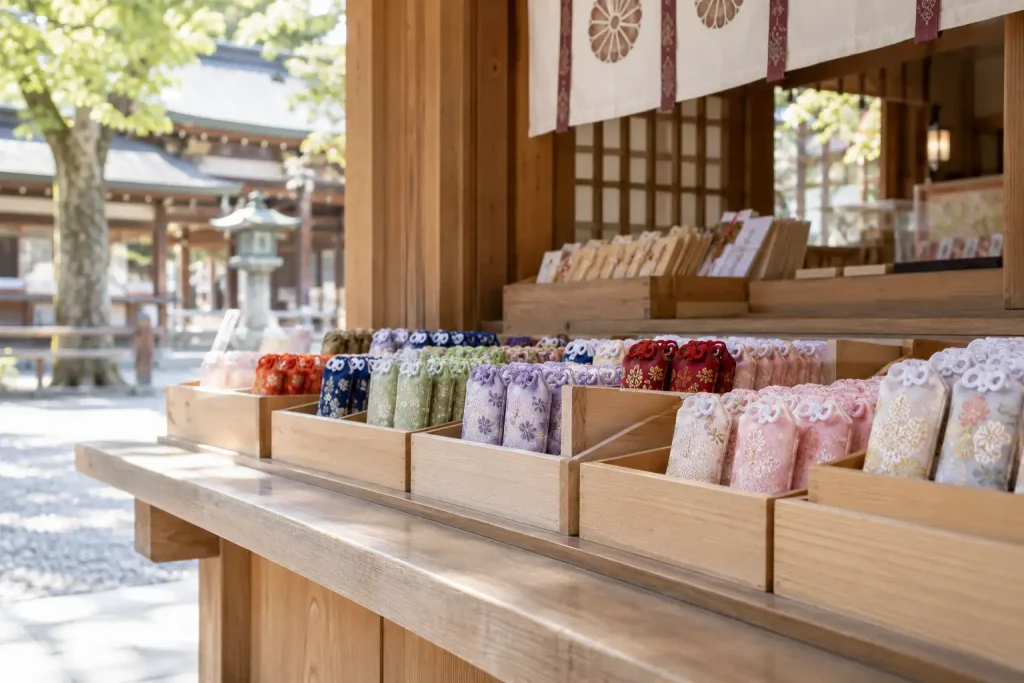
Omamori meaning starts with four words at the counter
御守り, omamori, literally “protection,” is the general word for the portable amulet. The honorific prefix 御, o, is part of the familiar form, while 守り, mamori, comes from the idea of guarding or protecting. You meet the term on signs, labels and questions such as “Which omamori is for travel?” The common mistake is translating it only as “lucky charm.” Protection, prayer and a specific intended benefit are closer to how it functions than random good luck.
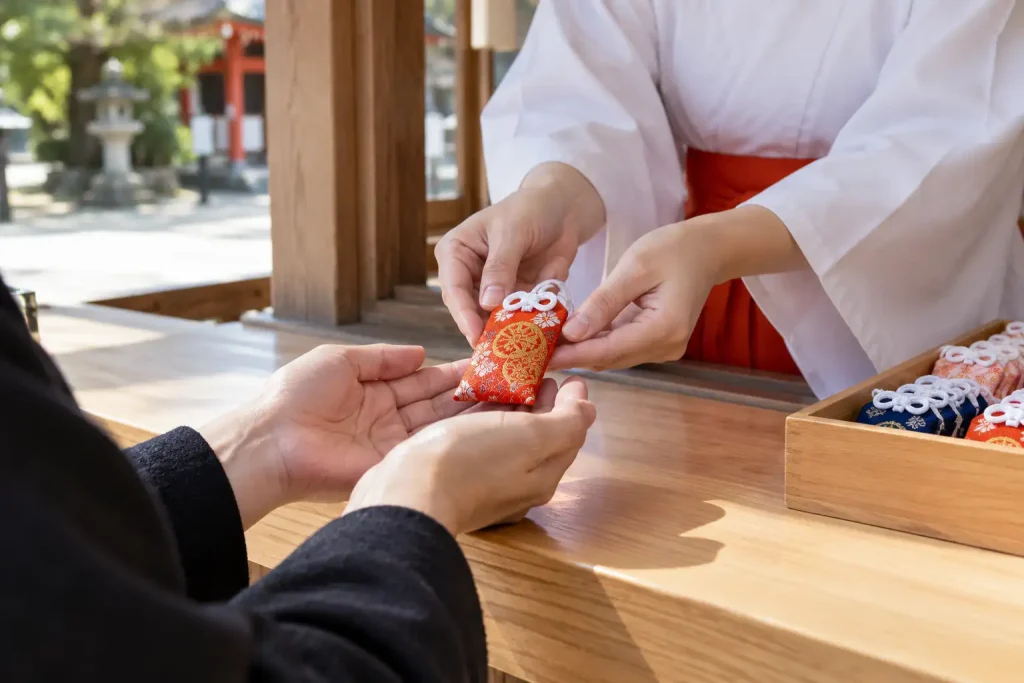
授与所, juyosho, literally “bestowal place,” is the shrine or temple counter where you receive amulets, talismans and sometimes fortunes. This is the first term whose English equivalent can mislead you: it looks like a gift shop, but it is not described institutionally as a retail store. Religious sites use verbs such as 授ける, sazukeru, “to confer,” rather than 売る, uru, “to sell.” You still hand over money, but the vocabulary frames the exchange as receiving a sacred item.
初穂料, hatsuho-ryō, literally “first-fruits offering,” is the amount shown beside many Shinto amulets and rites. Historically, 初穂, hatsuho, referred to the first rice offered to the kami; at a modern counter it means the monetary offering requested. The visitor mistake is asking for the “price” and then assuming the absence of a conventional price tag means the charm is free. If a displayed amount says ¥800, that is what you should offer.
授かる, sazukaru, “to receive or be granted,” is the verb you may hear when someone talks about obtaining an omamori. It does not mean grabbing a free giveaway. The English word “receive” can suggest passivity, but here it signals that the item is conferred by the religious institution. In ordinary visitor English, “buy” communicates the transaction clearly; at the site, recognizing sazukaru helps you understand its religious register.
“The requested money is an offering, and the pouch is something received—not ordinary souvenir stock.”
The distinction does not require you to perform belief. It does explain why opening the pouch simply to see what your money bought misses the point of the object.
Which charm to ask for—and what it currently costs
The most common omamori types are named for a purpose rather than for a decorative style. You will usually see the purpose written on the pouch or its label. Designs and offerings vary from one institution to another, so there is no national catalog and no universal fixed price.
The table uses amounts published by operating shrines and checked on September 16, 2026. Dollar conversions are approximate, using about ¥155 to US$1, close to the Bank of Japan’s mid-September 2026 market data. Exchange rates and shrine offerings can change, so treat the dollar column as a travel-budget estimate rather than a counter price.
| Type | Japanese and reading | Intended purpose | Verified example | Published offering |
|---|---|---|---|---|
| General protection | 御守, omamori | Everyday safety and protection | Shrine-dependent | Common examples fall around ¥700–¥1,000 ($4.50–$6.45) |
| Traffic safety | 交通安全守, kōtsū anzen mamori | Driving, cycling and travel safety | Nanasha Shrine | ¥700 (about $4.50) |
| Academic progress | 学業守, gakugyō mamori | Study and improvement in learning | Nanasha Shrine | ¥700 (about $4.50) |
| Exam success | 合格守, gōkaku mamori | Passing an entrance, licensing or employment exam | Nanasha Shrine | ¥700 (about $4.50) |
| Safe childbirth | 安産守, anzan mamori | Pregnancy and safe delivery | Nanasha Shrine | ¥1,200 (about $7.75) |
| Relationships | 縁結び守, enmusubi mamori | Forming a meaningful connection | Tokyo Daijingu | ¥800–¥1,000 (about $5.15–$6.45) |
| Health | 健康守, kenkō mamori | General health | Nanasha Shrine | ¥700 (about $4.50) |
| Recovery from illness | 病気平癒守, byōki heiyu mamori | Recovery from an existing illness | Nanasha Shrine | ¥1,200 (about $7.75) |
| Business | 商売繁盛守, shōbai hanjō mamori | Business prosperity | Shrine-dependent | Verify at the counter |
| Protection from misfortune | 厄除守, yakuyoke mamori | Avoiding or clearing misfortune | Shrine-dependent | Verify at the counter |
That evidence supports a more careful price line than “all omamori cost ¥500 to ¥1,000.” Many standard examples do sit near ¥700–¥1,000, but current official listings also include ¥1,200, ¥1,400 and higher amounts. Seimei Shrine in Kyoto, for example, lists a traffic-safety charm at ¥1,400 as checked on September 16, 2026. The exact offering depends on the institution and design.
What the main inscriptions mean when you need them
交通安全, kōtsū anzen, literally “traffic safety,” appears when you want protection on the road. It is not limited to car owners: Meiji Jingu’s official description notes that related stickers can be used on cars, helmets and baby strollers. The mistake is reading “traffic” as “automobile only.” A cyclist or regular traveler can choose it without owning a car.
学業成就, gakugyō jōju, literally “academic achievement fulfilled,” is for learning and educational progress. You meet it when starting a school year, taking on a difficult course or giving a thoughtful charm to a student. It is broader than a pass-or-fail examination. The frequent mistake is treating it as identical to 合格祈願, gōkaku kigan, “prayer for passing,” which is focused on a particular exam or selection result.
安産, anzan, literally “safe childbirth,” is intended for pregnancy and delivery. This is another case where the English loanword “charm” sounds too casual: the object may be part of a serious family observance and is not a novelty baby-shower accessory. You meet it at shrines associated with childbirth or when someone close to you is expecting. Do not assume it replaces medical care; it expresses a prayer, not a clinical guarantee.
縁結び, enmusubi, literally “binding connections,” is often marketed in English as “love.” That translation is narrower than the Japanese. 縁, en, can include romantic, social and other meaningful human connections. Tokyo Daijingu’s popular lily-of-the-valley versions were listed at ¥800 on September 16, 2026. The mistake is assuming every enmusubi charm promises a boyfriend, girlfriend or wedding.
If you want to pray before visiting the counter, Two Bows, Two Claps, One Bow: The Sequence covers the shrine procedure. For the visual difference between the two kinds of religious site, Jinja vs Otera: The Five-Second Test explains what to look for without turning the distinction into a theology lecture.
The pouch stays closed
The defining rule of the Japanese omamori pouch is easy to follow: do not open it. The fabric is not decorative packaging waiting to be removed at home. It encloses the internal sacred object, often called an 内符, naifu, “inner talisman,” and keeping that object enclosed is part of how the amulet is treated.
This rule is widely stated in cultural explanations, but shrine websites do not all publish an identical doctrinal reason. You may hear that opening the pouch allows its sacred power to escape. A more evidence-conscious way to put it is that the enclosed object is not intended for inspection and the closed form should be respected. Opening one does not trigger a documented penalty, curse or guaranteed run of bad luck; it means you have disregarded the convention governing the object.
Practical handling is less complicated than souvenir guides make it sound:
- Keep the pouch closed.
- Carry it in a bag, wallet compartment or another place connected to its purpose.
- Protect it from being crushed, soaked or treated as loose clutter.
- Do not panic if it becomes worn; ordinary wear is a predictable result of carrying it.
- Avoid promising anyone that an amulet guarantees an exam result, safe journey or recovery.
You can carry more than one. No central Shinto rule says that different kami will become jealous and cancel one another’s protection. The more useful limit is practical: choose amulets with purposes you can remember and treat respectfully.
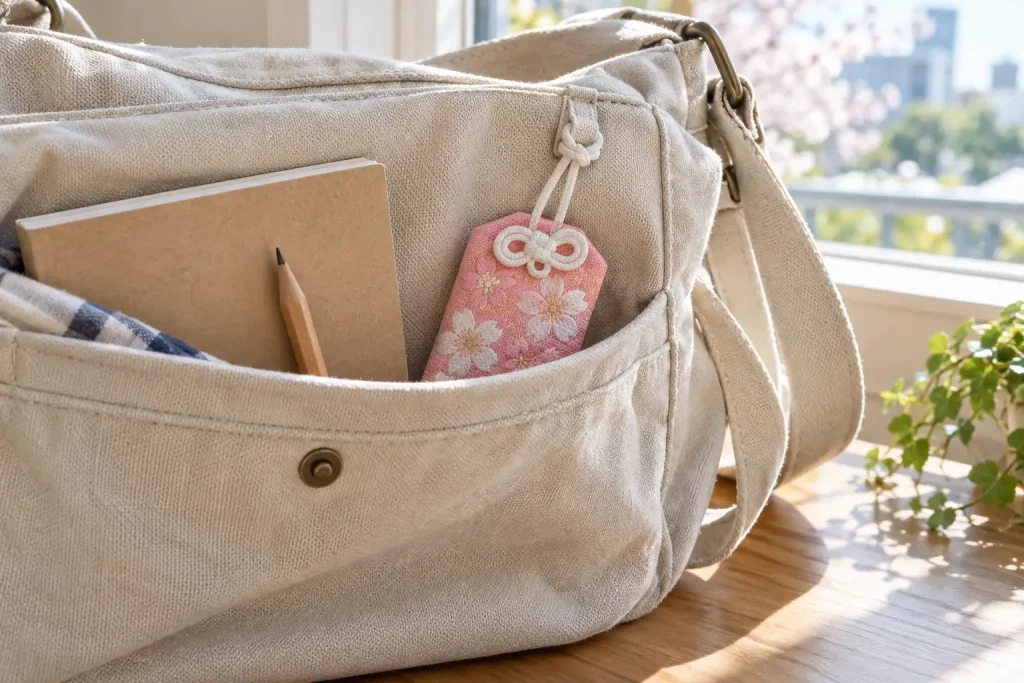
The one-year rule is a custom, not a countdown clock
The familiar omamori one year rule needs one correction. An omamori does not become harmful at midnight exactly 365 days after you receive it. Santai Shrine’s official guidance says there is no clearly fixed period of effectiveness, while recommending one year as the point at which an old charm can be returned and replaced.
“The effect has no clearly fixed deadline, but use one year as a guide.” — Santai Shrine guidance, checked September 16, 2026
Why, then, does “one year” appear so often? New Year is a natural renewal point. During 初詣, hatsumōde, the first shrine or temple visit of the year, people return older religious items and receive new ones. Japanese Festivals by Season: A Year-Round Guide covers that New Year visit as part of the annual calendar rather than repeating the entire custom here.
Purpose-specific amulets also have a logical endpoint. An exam charm can be returned after the result, and an anzan charm after childbirth, even when less than a full year has passed. Conversely, keeping a meaningful charm slightly longer is not evidence that it has turned bad. “About a year, or when its purpose is complete” is the defensible rule.
Where an old omamori goes
返納, henno, literally “returning,” is the act of giving an old charm back to a religious institution. This is the second English trap: “dispose of” sounds like ordinary waste management, while henno treats the item as something returned with thanks. The preferred destination is the shrine or temple from which it came.
古札納所, kofuda osamejo, literally “old-talisman deposit place,” is the labeled collection point you may find on the grounds. Meiji Jingu maintains such a place but explicitly accepts only its own amulets and talismans there. That restriction matters: you cannot assume that every famous shrine will accept a bag of religious objects collected across Japan.
If returning to the original site is impossible, ask a nearby institution before leaving the charm. Santai Shrine advises that a Shinto charm should go to a shrine and a Buddhist one to a temple. Procedures differ, so the least awkward solution is to check the official website or ask at the counter.
A responsible return looks like this:
- Identify whether the charm came from a shrine or temple.
- Return it to the issuing institution when reasonably possible.
- Look for 古札納所 or ask where old amulets are accepted.
- Follow local restrictions instead of assuming all items are welcome.
- Offer thanks; do not open the pouch before returning it.
- Receive a replacement only if you want one.
There is no need to fly from the United States to Japan solely to meet an exact anniversary. Keep the charm respectfully until an appropriate return becomes possible. If its label includes a Japanese era year, the era converter covers every year from 1868 through 2050 across all five modern eras.
The vocabulary worth keeping
You only need to memorize three terms. 御守り, omamori, tells you what the object is. 授与所, juyosho, gets you to the correct counter. 古札納所, kofuda osamejo, tells you where an old one may be returned.
The remaining vocabulary can stay at recognition level. Notice 交通安全 for travel, 学業 or 合格 for study and exams, 安産 for childbirth, and 縁結び for connections. You do not need to deliver a perfect Japanese sentence to choose correctly; pointing to the label and confirming the purpose is enough.
The broader principle matches Japanese Etiquette for Visitors: What Actually Matters: respect the boundary the object creates. In this case, the boundary is the closed pouch. Carry it, protect it, return it when its purpose is finished—and resist the urge to unzip the one part you were never meant to inspect.
Glossary at a glance
| Term | Reading | Literal meaning | Where you meet it |
|---|---|---|---|
| 御守り | omamori | Protection | Shrine or temple counter |
| 授与所 | juyosho | Bestowal place | Counter issuing sacred items |
| 初穂料 | hatsuho-ryō | First-fruits offering | Amount displayed at a shrine |
| 授かる | sazukaru | To receive or be granted | Descriptions of obtaining an amulet |
| 交通安全 | kōtsū anzen | Traffic safety | Road and travel charms |
| 学業成就 | gakugyō jōju | Fulfillment of academic achievement | Study charms |
| 合格祈願 | gōkaku kigan | Prayer for passing | Exam charms |
| 安産 | anzan | Safe childbirth | Pregnancy charms |
| 縁結び | enmusubi | Binding connections | Relationship charms |
| 内符 | naifu | Inner talisman | Inside the closed pouch |
| 返納 | henno | Return | Giving an old charm back |
| 古札納所 | kofuda osamejo | Old-talisman deposit | Return point at a religious site |
| 初詣 | hatsumōde | First visit | New Year shrine or temple visit |
Frequently asked questions
Is it bad luck to open an omamori?
Opening the pouch violates the convention that the internal talisman remains enclosed. Cultural explanations often say opening it releases or weakens its protection, but no primary source reviewed for this draft documents an automatic curse or punishment. Leave it closed out of respect rather than fear.
Does an omamori expire after exactly one year?
No. Official shrine guidance describes one year as a customary guide, not a precisely fixed expiration date. You can also return a purpose-specific charm when the event has passed, such as after an exam or childbirth.
Can tourists receive omamori?
Yes. You do not need Japanese citizenship or fluency. Check the written purpose, offer the displayed amount and treat the object respectfully.
Can I give an omamori to someone else?
Yes. A study, travel, health or childbirth amulet can be a considerate gift when its purpose suits the recipient. It should not be presented as a guarantee of a result.
Can I keep several omamori?
Yes. There is no verified universal rule limiting you to one or claiming that different deities inevitably conflict. Keep only as many as you can carry and treat appropriately.
Can I return an omamori to any shrine?
Not automatically. Returning it to the issuing institution is preferable, and some sites accept only their own items. If that is impossible, ask locally and keep Shinto amulets with shrines and Buddhist amulets with temples.